
A printing plate is the flexible plate that transfers the image to the material in flexo printing. The text and shapes to be printed stand in relief on the surface of the plate; only these raised areas pick up the ink and lay it down on the material. It resembles a rubber stamp with each letter in relief, but it is far more precise and, wrapped around a cylinder, runs at hundreds of metres per minute.
What is a printing plate made of?
Today most printing plates are made from photopolymer. Photopolymer is a material that hardens wherever it is exposed to ultraviolet (UV) light. The rubber plate, an older method, is prepared by laser engraving and is still used for some special jobs.
How is a printing plate prepared?
- Colour separation: The design is separated into an individual image for each colour to be printed. A four-colour job needs four printing plates.
- Exposure: The image is transferred to the photopolymer sheet and the sheet is exposed to UV light. The areas that receive light harden.
- Washing: The unhardened areas are washed away; the relief image remains.
- Drying and final exposure: The plate is dried and, with a final exposure, brought to the hardness needed to withstand printing.
- Mounting: The plate is fixed to the plate cylinder or to a sleeve with double-sided tape. Mounting must be done precisely so that the colours sit exactly on top of one another.
Is a separate printing plate needed for each colour?
Yes. In flexo printing each colour is printed in a separate unit, and each unit has its own printing plate. The number of colours on the machine therefore determines how many colours can be printed in a single pass: four plates run at the same time on a 4-colour machine, eight on an 8-colour machine.
What do plate thickness and print length change?
Plate thickness is chosen according to the material and the job; thin plates are preferred for fine detail, thick plates for rough surfaces and demanding materials such as sacks. The print length (repeat length) depends on the circumference of the cylinder the plate is wrapped around. On our BMS and BMS-D series the print length is 300–900 mm, and on the BMS-SC series we developed for sack printing it is 300–1300 mm.
What is the relationship between the printing plate and the anilox roller?
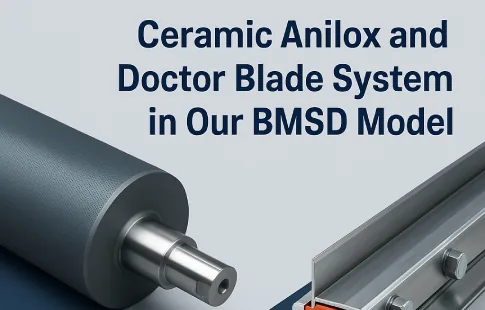
The anilox roller supplies the ink to the printing plate. If the anilox cells are too large, fine details fill in; if they are too small, solid areas look pale. That is why the anilox is chosen according to the detail of the job on the plate. Because the Dr. Blade system and ceramic anilox deliver the same amount of ink to the plate on every revolution, the colour stays constant throughout the run. For details, see our article on ceramic anilox and Dr. Blade.
How can the life of a printing plate be extended?
- After printing, clean the plate with a suitable cleaner before the ink dries.
- Store printing plates flat or wrapped around a cylinder, away from light and heat.
- Do not raise the printing pressure more than necessary; excess pressure both wears the plate and thickens the dots.
- If you are going to print the same job again, label the printing plates and store them; a well-kept plate can be used many times.
Plate preparation is mostly done by plate-making workshops (repro houses); the printing machine, for its part, runs the plate at the right pressure and in correct register. For questions on the machine side, you can write to us.